Garlic Butter Croissant Sourdough
A buttery sourdough loaf with layers of garlic butter laminated throughout the dough, creating a crisp golden crust and soft, flaky layers reminiscent of a croissant.
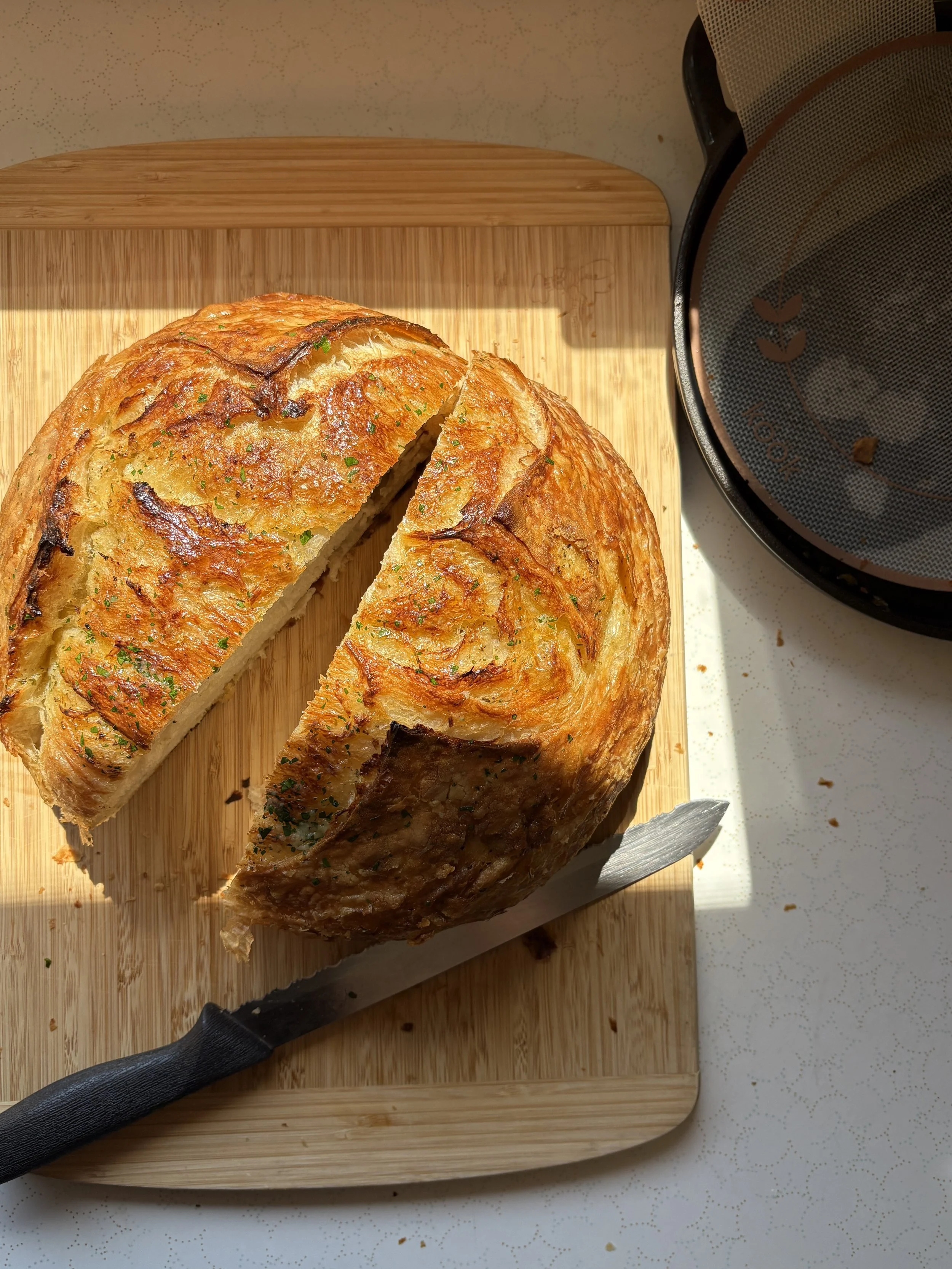
Makes: 1 loaf I Prep: 30 minutes I Bulk Rise: 5-7 hours I Cold Proof: 8-16 hours I Bake: 40 minutes
Dough
Ingredients
100 g active sourdough starter
375 g filtered water, room temperature
500 g bread flour
10 g fine sea salt
1 stick (8 tbsp / 113 g) garlic butter, frozen
Instructions
Freeze the butter. Freeze the stick of garlic butter for at least 30 minutes. Once firm, grate it using the large holes of a box grater, then return the grated butter to the freezer until needed.
Mix the dough. In a large bowl, combine the filtered water and active sourdough starter. Whisk until the starter is mostly dissolved and the mixture looks milky.
Add the dry ingredients. Add the bread flour and salt. Mix with your hands until a shaggy dough forms and no dry flour remains.
Rest. Cover the bowl and let the dough rest for 30 minutes.
Being the stretch + folds. Perform 4 sets of stretch and folds, spaced approximately 30 minutes apart.
Laminate the garlic butter. During the second set, gently stretch the dough out and add half of the frozen grated garlic butter, folding the dough over itself to enclose the butter. During the third set, repeat with the remaining garlic butter. Keep the butter as cold as possible while working.
Bulk fermentation. After the final stretch and fold, cover the dough and let it rise at room temperature for 5-7 hours, or until it looks noticeably puffy, aerated and jiggly and has risen substantially.
shape + cold proof
instructions
Turn out the dough. Gently turn the dough onto a lightly floured work surface, being careful not to deflate it too much.
Shape. Lightly wet your hands and gently stretch the dough into a rectangle. Fold one side into the center, then fold the opposite side over it, like folding a letter.
Build tension. Starting with the end closest to you, roll the dough into a tight ball. Use a few gentle push-and-pulls against the counter to create surface tension.
Transfer to the banneton. Place the dough seam-side up in a well-floured banneton. If you don’t have one, use a bowl lined with a generously floured tea towel.
Cold proof. Cover and refrigerate for 8-16 hours.
bake
instructions
Preheat. Preheat oven to 450°F (230°C) with your dutch oven inside. Allow the dutch oven to fully preheat before baking.
Score the loaf. Remove the dough directly from the refrigerator and turn it onto a piece of parchment paper. Score the top of the loaf as desired.
Bake uncovered. Carefully transfer the loaf into the hot dutch oven. Cove and bake at 450°F for 30 minutes.
Finish uncovered. Remove the lid and reduce the oven temperature to 400°F (205°C). Bake for another 10-15 minutes, or until the crust is deeply golden brown.
Cool. Transfer the loaf to a cooling rack and let it cool for at least 1 hour before slicing. This gives the crumb time to finish setting.
notes
Garlic butter: I use Kerrygold Garlic & Herb Butter, but another high-quality garlic butter will work. Keep it frozen until you’re ready to laminate it into the dough so the butter stays in distinct pieces rather than melting into the dough.
Bulk fermentation: Use the dough rather than the clock as your guide. It should look noticeably rise, aerated, and jiggly with bubbles visible along the sides and surface. Fermentation time will vary with starter strength and kitchen temperature.
Keep the butter cold: If the butter or dough begins to feel warm or greasy during the stretch-and-fold process, place the dough in the refrigerator for 15-20 minutes before continuing.
Cold proof: An 8-16 hour refrigerated proof develops flavor and makes the loaf easier to score. Bake it directly from the refrigerator.
Cooling. As tempting as it is to cut into it immediately, give the loaf at least 1 hour to cool. Slicing too early can result in a gummy crumb.
Storage. Store the cooled loaf in an airtight container or bread bag at room temperature for up to 2 days. For longer storage, slice and freeze.